Tag: tokyo

  • Haneda Airport and Ikebukuro (4.24.24)

    Since we’ve been on a plane for 13 hours, common sense dictates that everyone would be in a hurry to get off the plane. We would all act with grace and speed, restlessness propelling us forward. This was not the case. I wanted to tear my eyelashes out from impatience as everyone on the plane acted as if they had never deplaned before in their lives. I practically wept to touch the earth again–or at least the floor of the Haneda airport–once I left the suffocating tin can of an airplane.

    Airports are funny places, practically their own city-states when you account for their huge populations, multiple security forces, customs and immigration, service workers and maintenance crews. You could probably live in an airport your whole life, with an occasional sad thought for the trees and fresh air.

    I was in the limbo of airports, one where you navigate the bureaucratic gauntlet to make it outside. The subtle layer of fear beneath my navigation is a paranoia that I (like some) will not make it out of the airport. I follow a long, desolate hallway that leads to customs and never seems to end. I walk as fast as I can, though I have no idea why. Perhaps I am spurred by a desire to “beat” my fellow passengers who had proven themselves slow and inept in the deplaning process.

    In this hallway, there are no creature comforts; there is nowhere to stop for food or water. You must keep moving. On giant banners above us, large Japanese faces smile down at us, kanji printed as tall as I am. I cannot read the kanji, so as far as I’m concerned, they could have been advertising toothpaste or government control.

    Immigration is always more confusing than it needs to be, but I followed another piece of travel advice that saved me considerable time. I filled out the online forms first. I can skip the tiny desk with its golf pencils and incomprehensible slips of paper, going straight to the line in which an official will stamp my passport. I get stuck behind a family of three Germans who are giving the official a complex.

    He eventually waved them away and I stepped up, handing him my passport. He was a younger Japanese man with tired eyes. A black mustache and goatee matched his short ponytail. He rubbed his eyes behind his glasses as he vaguely gestured. I scan my QR code on the machine in front of me. Neither of us spoke.

    My QR code was incorrect, so, with a look of subdued irritation, a flicker of his right eyelid really, he asks for the Japanese address. I show him my AirBnb. He pulled out a scrap of paper and wrote how I needed to enter the information in the program. It turns out I had put all the information in the wrong place. I had failed, already, to be a perfect traveller.

    Information now satisfactory, he flipped through my almost empty passport (a stamp for Dublin almost ten years earlier; and London two years ago) and put a sticker with Mt. Fuji on a pink background. I thanked him, in English because I didn’t trust myself to say arigato gozaimasu. He nods impassively and waves me away.

    Because I am incapable of moving at a leisurely pace or enjoying my life, I initiate my journey through the rest of the airport with an attitude more fitting for Escape from New York than a twenty-first century airport. I walked faster than was strictly comfortable, dodging slower people and obstacles, picking up speed, until–

    Stopped.

    For yet another checkpoint.

    The Japanese woman who had stopped me smiles behind her mask, pointing to a sign printed in English. I have to fish my passport back out of my bag and scan it at a derelict kiosk. She nods approvingly and I yet again gather speed.

    (Aside: it will probably be redundant as I specify whether or not someone is Japanese; this is a bit of a holdover from being in the US. Japan, of course, is full of non-Japanese people, however much they’d like to forget this. But it is less diverse than I’m used to in the United States where affixing identity labels helps illustrate the kind of world we live in).

    ***

    After riding a train in the wrong direction, I eventually got to the Ikebukuro train station. This station is my first stop because of food and because my AirBnB will be nearby.

    I had never experienced a train station quite like Ikebukuro and many train stations in Tokyo at least are, in fact, constructed with shops, bathrooms, restaurants. (I hadn’t yet been to Tokyo Station, which blows my mind each time I set food in it.) They are like airports in that way. If you go to New York City, for example, there are not shops in the subways. Given the American penchant for commodifying everything, this seems very strange. But here, in Japan, it seems to be both commercial and a matter of care. Of course people who take trains will be hungry!

    The train station would have been more dazzling if I wasn’t so tired and hungry. I was looking for T’s TanTan, a vegan ramen shop. I found it, a tiny place with sliding glass doors. As I stepped inside, the workers shouted something at me, which was very frightening, but now I know they were saying “Irasshaimase,” a polite welcome. You ordered everything via a touch screen, requiring no Japanese. The images explained what the English captions would not. They made cup ramen, as well, so I ordered extra in case I was still hungry at the AirBnB.

    They announced your order by number which was a problem because I did not know the numbers, but I took a guess when I saw 2 of their cup ramen on the tray. I hand my receipt to the worker, feeling embarrassed, and she says something I don’t understand so I just smile and nod.
    a bowl of ramen
    T’s TanTan seasonal ramen with rice, pickles, and dessert.

    I recognized everything on my plate except the small cup in the upper right hand corner. I wondered: is it some sort of sauce? Am I supposed to dump it into my ramen? I took a taste. I am very glad I didn’t dump it into my ramen. It is my dessert, a coffee liqueur over a yogurt base. I inhale my creamy ramen that has delicious faux-chicken. The rice grains are plump and delicious. The pickles wonderfully sour. Being vegan in Japan is rough-going, so T’s TanTan will be a lifeline while in Tokyo. (I’ll eventually find out they are not in other cities, sadly.)

    After practically inhaling my food, I am lost in Ikebukuro station for about twenty minutes before I finally find my way above ground. I am terrified at the idea of getting to my AirBnb which is in a neighboring area called Takada/Toshima City.

    It rained, of course, the entire time I walked toward the apartment. It takes me a half hour and my shoulders ache under the weight of my backpack. My roller bag causes my arms to fatigue. The sound of its wheels on the stone made me want to scream in annoyance. My phone screen gathered raindrops. I am tired and am running out of all civilized behaviors as I realize how strangely arranged streets are here. Tokyo streets are like tree branches rather than a grid, some small and dead-ends, other major thoroughfares. I am frequently lost and my google maps loads slowly as it reroutes me again and again.
    Shrine Gate in Tokyo Japan.
    Gate to a Buddhist temple in Toshima City.

    But, through the rain, I get a first glimpse of the Japan. There’s a temple in the neighborhood, its gate closed at this late hour (it’s almost eight o’clock). There are large, gold ideographs on the gate and stone statues on either side. This is from a different history, a different philosophy. The neighborhood is small and seems to me haphazardly arranged, so it will take me another two days to find this gate again.

    I eventually find my way to the AirBnB. I am utterly baffled by the door. A Japanese man who is coming out of one of the other apartments sees my distress and attempts to help me. He explains, after my suspicious look, that he cleans these apartments. He smiles behind his mask. Together, we get the door open. I nod my thanks and dart inside.

    Later, reflecting on this incident, I felt like I was the rudest person on the whole planet. The Japanese would surely send me home.

    My initial appraisal of the room–tired and scared as I was–was not generous. Small and drab I felt (I didn’t even take pictures of it). There was a thin mattress, a small folding couch and a tiny desk in the corner of the bedroom. A door separated it from the kitchen and the bathroom. I came to adore this place and wished my own apartment at home was laid out like this. One of the things I missed the most was the genkan, the small depressed spot at the entry where you leave your shoes before stepping up into the apartment.

    This was my first Japanese bathroom. The tub had no shower curtain and the sink and shower shared the same valve mechanism. The tub was big enough for your entire body–American tubs are longer but not deep like Japanese tubs. The entire bathroom was brown except the floating toilet. It was a rather strange color and effect.

    I was too tired to do much but lay down on the bed at eight o’clock. Little did I know, I would hardly sleep at all.
  • In Transit (4.23.24)

    I’m not sure I can explain why I am going to Japan. Friends and family ask but I have no answer. Many of them tell me, “I’ve always wanted to go!” When I ask why, they are equally stumped. Our curiosity is vague.

    I took an Eastern literature class my freshman year of college, a class I took with my then boyfriend (now spouse), Z. Of the literature we studied, I was most captivated by the Japanese texts: The Pillow BookThe Tale of GenjiIn Praise of Shadows. Our professor showed us Noh and bunraku performances before we watched Spirited Away. (Recently, Z and I watched this, me thinking it had been my first time. He reminded me that we had watched it before.)

    Since then, I have ready just about every Japanese novel I could get my hands on. There is something indelible about these Japanese novels, a matter-of-factness that is somehow also avoiding speaking directly. There is a deceptive simplicity. I don’t know how to describe it, but they leave me with a particular feeling by the time I’m done reading and I wish to write the world like they do. They stir my mind.

    Somehow, the logical consequence of this decade long curiosity was to board a plan and stay for 40 days.

    But not, I now observe, to learn the language. I am in possession (on this plane, on my way to Tokyo) of three phrases in Japanese. Konnichiwa, sayonara, and sumimasen. I’m hoping that the legend of Japanese hospitality is all it is rumored to be. Learning a language in isolation is difficult and I begin to panic when confronted with the incomprehensible signs of Japanese. I know it’ snot impossible–but I decided to take the risk of travel while hoping for the best.

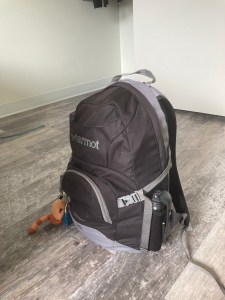
    My trusty backpack, stuffed with what I need. It is the best friend I’ve ever had in my journeys!

    ***

    The plane I board from Detroit Ft. Worth airport is the biggest I have ever flown on. There are no final, desperate calls for gate check, as there usually are when I fly out of my home airport in Helena, MT. I have flown from Helena to Detroit because there is a direct flight from DFW to Haneda. I stayed the night in a questionable airport hotel, hoping splitting travel would make it less miserable.

    Now I really am on my way.

    For those of us in economy, there are three sets of three seats per row and they seem to stretch backward into eternity. Ahead, in comfort and first class, there are far fewer seats, seats that recline and shield the traveler from the inconvenience of other people. Even though the only ticket I could afford was economy (and it was still roughly $900, not including my flight from MT), I had an entire row to myself!

    I buckled up and then ponder, as the final passengers board and the flight attendants do their final checks, what on earth I am going to do for the next thirteen hours of my flight. I have dreaded this coming confinement, a terrifying prospect, a sacrifice I must make to get to Japan. I realize that shuttling from midwest America to Japan in only thirteen hours is a miracle of human engineering, a journey that would have taken far longer earlier in history. Isabella Bird would probably have given her right arm to make that journey shorter.

    (Aside: what do we lose when our goal is to get from one place to another as quickly as possible? Why is efficiency and speed always the goal of travel? In America, we have very little time off, so there’s a personal reason. The reason we have so little time off is because of capital, of course. This mode of travel is specific to capitalism, which needs to do everything as quickly as possible to generate more profit. Further, the airline industries are heavily subsidized by state governments. In the US, during COVID, the airline industries were bailed out because they were financially irresponsible. I hate that public money went toward private gain; these airlines rake in profits while making flights more miserable and destroying the environment. Anyway, if we want to recover other modes of travel, we’ll have to fight for funding for trains, boats, etc.)

    The pilot announces take-off. I have already taken my motion sickness medicine and closed my eyes in preparation. Normally, take-off is the worst part of the flight for me (except for having to deal with the petty dictatorship of TSA) but I fall asleep briefly, waking when the pilot announces there it will be a 12 hour flight to Tokyo.

    Twelve hours!

    Prior to travel, I read many blogs and reddit posts about how to cope with the huge time difference. Clear instructions: try to sleep while you fly, lining up your body clock with your destination’s time zone. Wear compression socks. Stand often so you don’t get Deep Vein Thrombosis (always capitalized). I followed all the advice except the socks. Thirty dollars for knee high socks seemed a bit much.

    In retrospect, it seems silly to try to “beat” jet lag, as you will be tired no matter when you arrive. You’ll have been traveling unnaturally fast. Your body protests this! Travel has its costs and flight tries to circumvent them, unsuccessfully. It seems best to just pay the cost rather than trying to avoid it. (More on this later.)

    The monotony of the flight was interrupted by the first meal service. I receive my meal before everyone else as I have “special” requirements. On my first international flight to Dublin, the food was barely edible. It was so bad. But this food is delicious. There’s a seasoned rice with curried okra. A small apple pie, too. It tasted a bit like chalk and coated the tongue much the same, but it was a nice touch.

    After my meal, I lay across the seats. I managed to sleep not one bit, suspended in the eternity that is not sleeping, in which time passes all at once and not at all. Eventually, I get up to use the closet-sized bathroom which is immaculate when you consider how many people are on the plane. I go back to my seats and wonder whether this hell will ever end. I wonder why I wanted to travel so far away from home in the first place.

    I was shaken awake gently by the flight attendant bringing breakfast at a biologically unsuitable time. I told the woman I couldn’t eat the meal and she is befuddled. I take the fruit off the tray and hand everything else back to her. I have snacks in my bag that will have to do.

    Looking at the time, it is morning and I’m supposed to be awake. According to the coffee in my hand, it is morning I’m supposed to be awake. By the glare of the lights, it is morning and I’m supposed to be awake. Something like my sleep command center, in my upper chest and connected to my eyes, disagrees with this state of affairs. I am so tired I will no longer be able to sleep.

    The only good thing to watch was a short season of Golden Girls so I sat through episode after episode, letting nostalgia wash over me. In this moment, I recognized that TV often functions this way in our day-to-day lives, a way to kill and waste time, a way to endure in time with one screen or another glued to our faces in an addictive loop. On a more positive note, I’m reminded of all the Golden Girls episodes I watched as a child at my grandmother’s house. The humor now is a little offbeat, sometimes sexist, but still has its witty moments and the relationship between Dorothy, Rose, Blanche, and Sophia is charming.

    As I finish the last episode (in which Stan has sex with Dorothy’s sister as a hurricane unfolds), the pilot announces that we are beginning our initial descent into Haneda airport. It is literally unbelievable to me that I am about to land in Japan.

  • blossoms and beauty in tokyo

    blossoms and beauty in tokyo

    I spent last week in Tokyo, soaking in the cherry and plum blossoms, as well as the public baths. I rested in gardens and hurried to catch the packed subway trains. I wandered along rivers and sat in cafes watching people go by.

    It was my last stretch of time without having to report to a job, though the job loomed at the end, quite like it might when you take a “normal” vacation. There’s always a sense of finite time. My experience of Tokyo this time was less full of possibility and more bittersweet than it was a year ago, precisely for that reason.

    But I loved my time there, just as I did the first time. I loved the unfamiliar sounds, both the songs and language. I now live in a small town (it calls itself a city, but I beg to differ) and so I do not hear the clatter of train cars or the announcers’ voices or the mix of many languages at any given time. So many different people come to Tokyo from all over the world, even from within Japan itself, so there’s also a real diversity of people moving through the city.

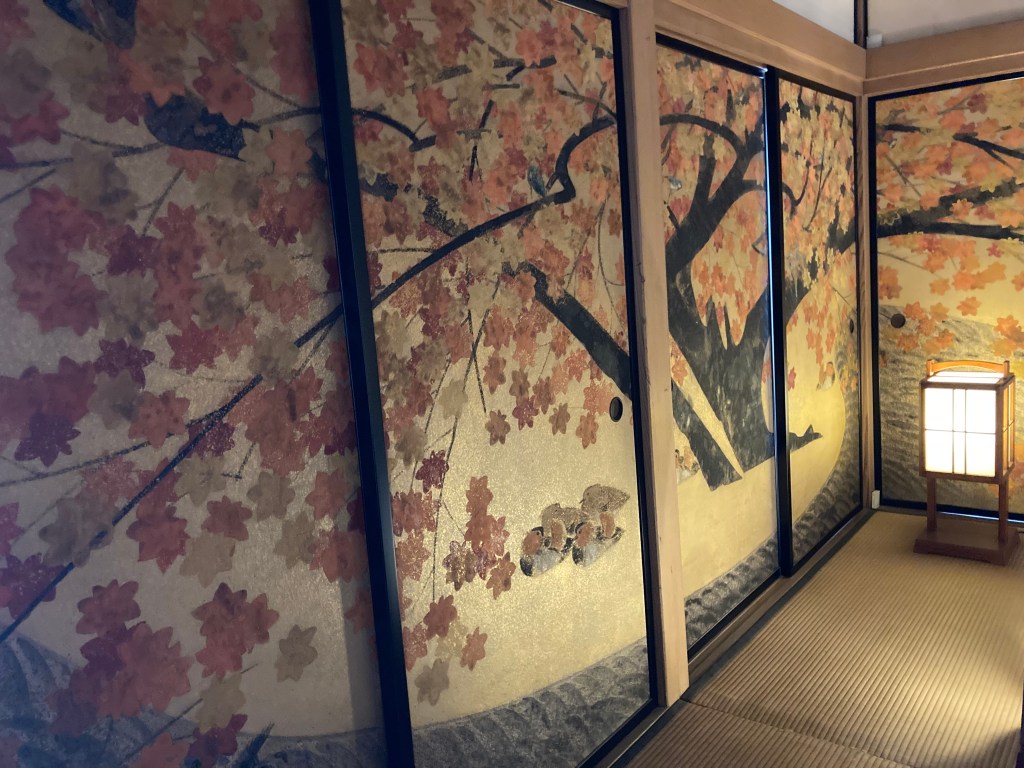
    I visited my third crown jewel garden, Kairakuen in Mito, about a two hour train ride from Tokyo. The garden’s name references a particular kind of pleasure and ease. This philosophical aspect of the garden felt like a natural conclusion to my time off, as both were something I thought in sustainable and nourishing forms. Much of the pleasure we have access to on a daily basis is not…healthy? It’s at least not sustainable, as we try to consume our way out of loneliness and mortality and lovelessness and anger. Instead, Kairakuen was a place for everyone to retreat to rest in the beauty of the plum trees and the exceptionally beautiful Koubountei, a three floor residence with rooms painted in different designs. Kairakuen, of the three crown jewels, was always treated as a public space rather than the domain of the wealthy.

    momiji (maple) room in Kobountei

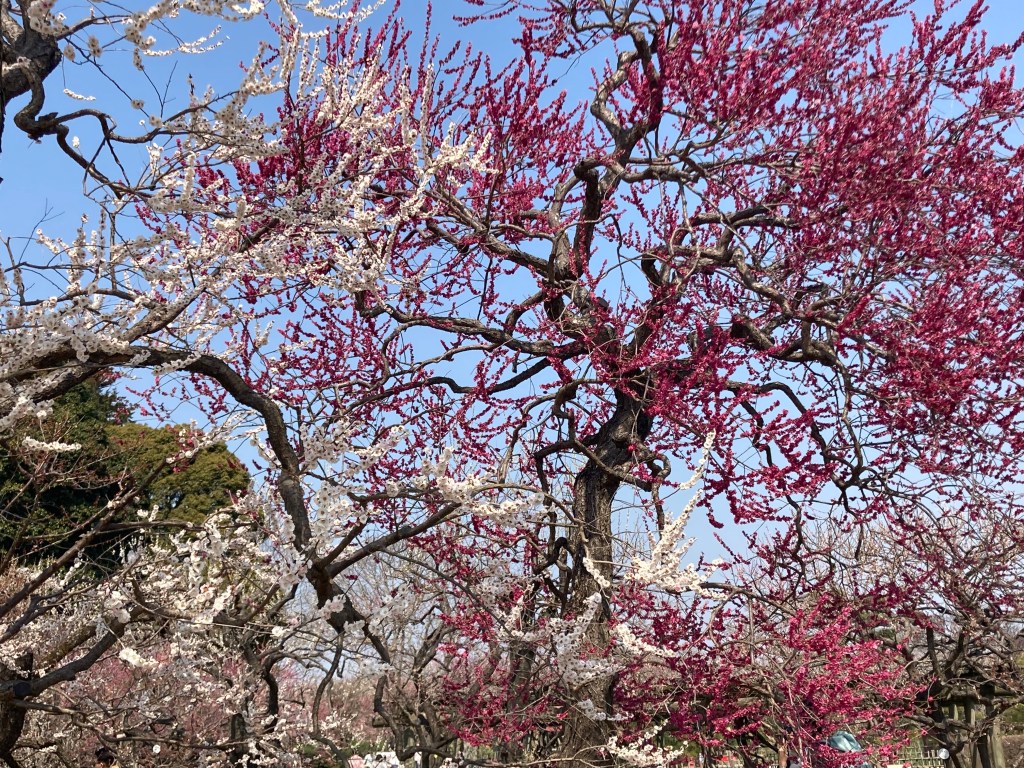
    The plum trees were still in bloom, so I wandered the plum grove multiple times, breathing in the scent of the trees. Photos can never capture smell and they fade from memory, only to be evoked in surprising ways later. (Proust taught us this, I suppose.) I was acutely aware of the impermanent nature of smell as I sat beneath the blossoms, enjoying my onigiri for the day. I enjoyed watching people show each other the blossoms, snatches of Japanese conversation floating toward me and away.

    white and fire-pink blossoms in Kairakuen

    I think the Japanese acknowledgement of the shaping relationship between people and nature is sound, much more sound than the culture I come from which views nature as valuable only for resource extraction or feelings of sublimity (these two things may be related). The Japanese garden is sometimes derided as being artificial to which the Japanese respond, rather sensibly, with “well…yeah.” Men cannot make mountains, though, in my country, they work very hard to destroy them. But in a Japanese garden, men can create mountains. Mountains can be made with carefully placed stones that evoke legend and symbolism. Ponds can stand for lakes, and the barest of fields suddenly becomes the plains. The Japanese gardens are worlds created to satisfy a need for beauty and one that engages all of our senses and faculties.

    Imagination is where beauty begins.

    I haven’t been working on any writing in the last two weeks, even this blog was a casualty of my travels and my job starting. But this problem of imagination and beauty, of how we restore our souls, especially when we don’t have money or means, interests me very much. That problem of restoration and beauty is the center of a story I’ve been working on for a couple of years about tiredness, inspired by Byung-Chul Han’s The Burnout Society. (That book actually saved my life.) Maybe I’ll get back to it since I’ve returned from trip, full of sustaining images and memories to get me through the workday.