Tag: relationships

  • wanting a different world (or: on dorothy day)

    wanting a different world (or: on dorothy day)

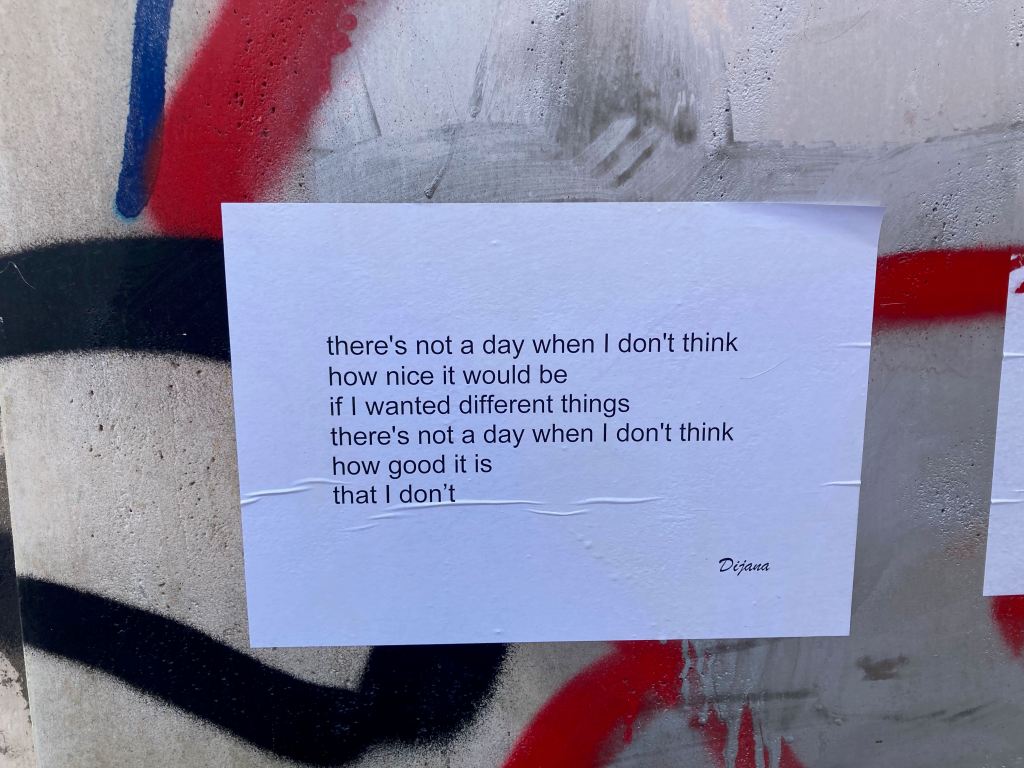
    “There’s not a day when I don’t think/how nice it would be/if I wanted different things/there’s not a day when I don’t think/how good it is/that I don’t.” –Dijana

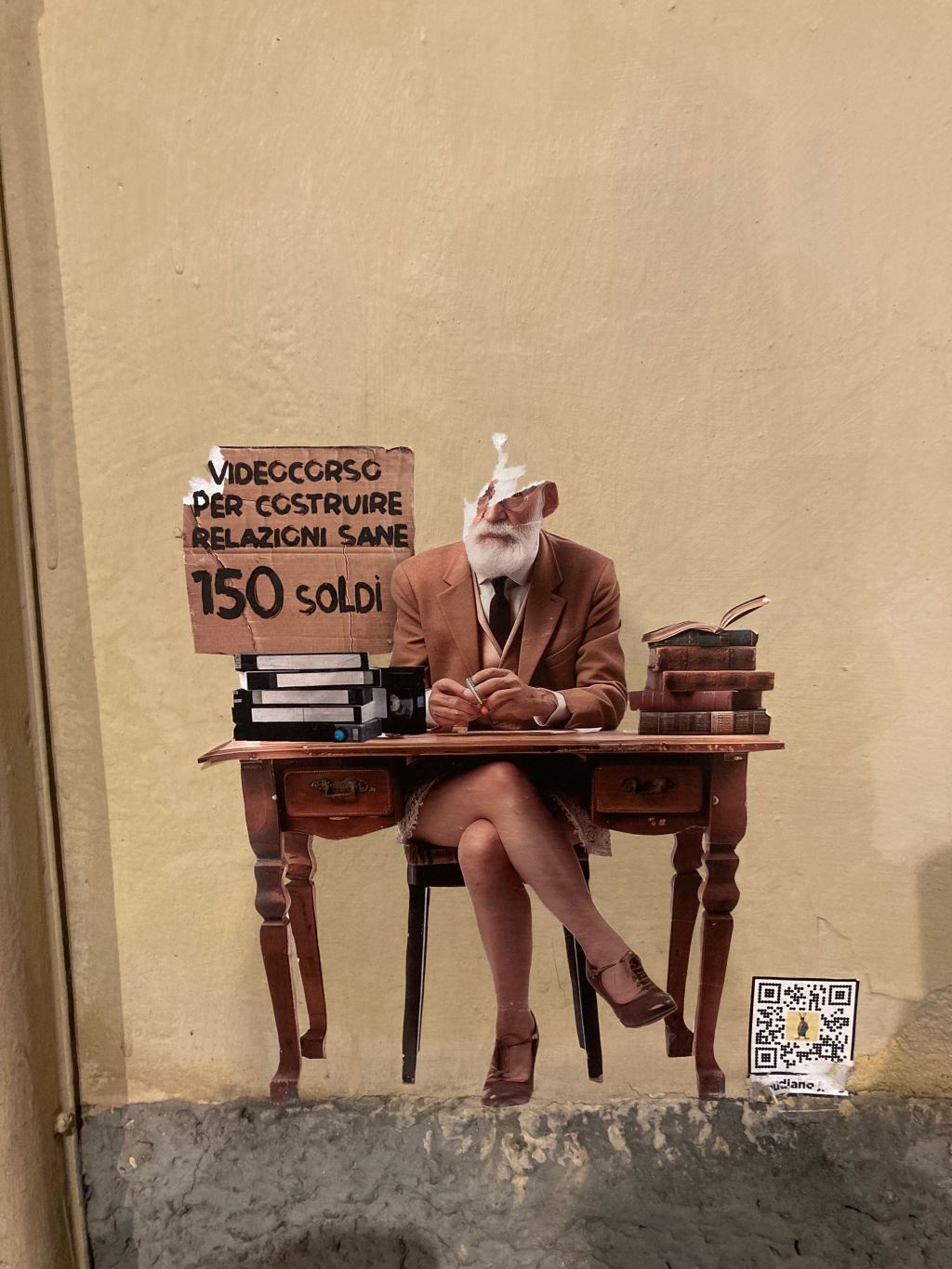
    I started thinking about this in my essay on Perfect Days, which is about the alternative hedonism presented by the movie, a vision of life in which commodities are not the center. This picture of some graffiti from my time in Italy reminded me of a central, difficult question about wanting things and what happens when you want things that are unavailable or not easily acquired by money.

    We can want things, commodities, as they present us with visions of ourselves as cool or complete or as somehow staving off the reality of finitude. I’m talking here about the things we don’t necessarily need or those objects that fill us with rapturous visions of who we could be rather than satisfying, say, our nutritional needs or our spiritual desires. We can also want things that are not things but are really forms of life: like better relationships; clean air; more kindness; health and happiness for our neighbors. But these things cannot be solved by buying things.

    It’s easier to want the thing rather than to want forms of life.

    This is why, as Todd McGowan argues, we in some ways like and want capitalism, because it arises from and satisfies things we as humans struggle with and desire. But like Dijana is saying in my photo, things start to get a little difficult when you stop wanting things and start wanting life. (I’ll refer you back to my blog title; less labor, more life!)

    I’ve been thinking about this even more now, reading the memoirs and diaries of Dorothy Day, having become interested in her as a result of Zena Hitz’s fabulous Lost in Thought: The Hidden Pleasures of Intellectual Life. I have always been drawn to the stories of those who follow the difficult path of living what they believe in. And in our moment, it is more necessary than ever, even though Day may roll her eyes at me saying that. She recognized that all moments in history are crisis; not just ours.
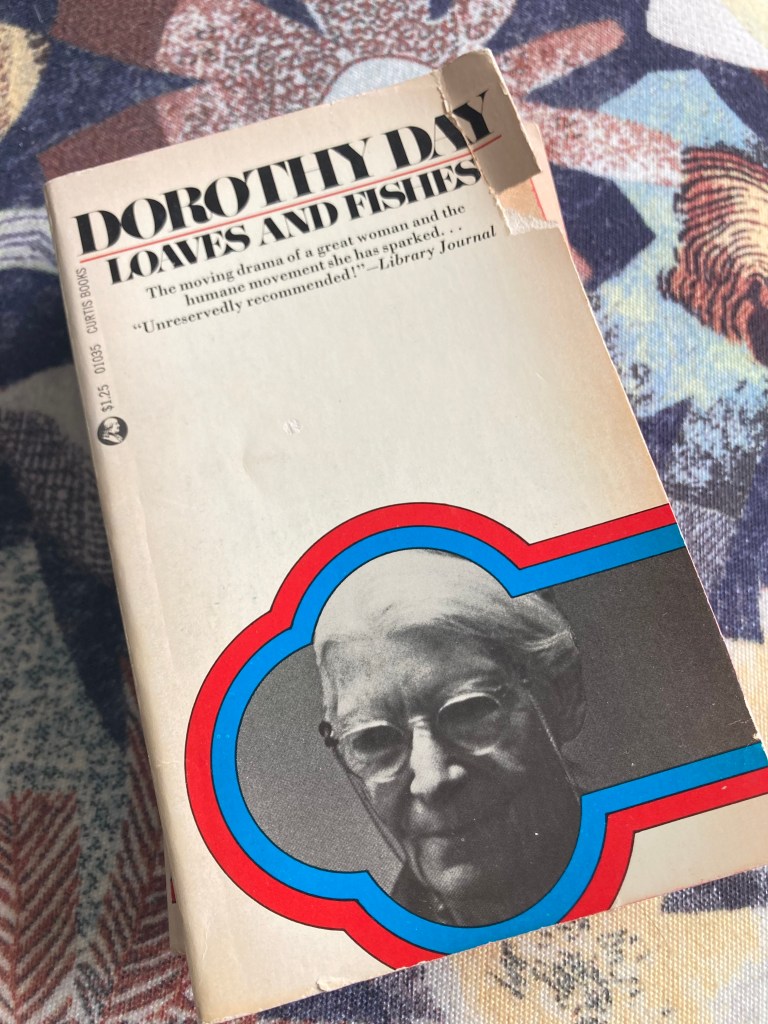
    My battered, Free Little Library copy of Dorothy Day’s Loaves and Fishes.

    The world looks very different if our words and lives come closer into alignment and Dorothy Day’s life demonstrates this powerfully. Her biography is easily accessible, but the two salient details for me are this: that a free, seeking youth lead her to communism and then to Catholicism. Becoming Catholic intensified her commitment to issues of social justice, especially poverty, labor struggles, and anti-war actions. Her life was a practice of living her values fully, in voluntary poverty, caring for the poor, tax refusals, and anti-war protests.

    For instance, Day writes an explanation for refusing to pay income tax in Loaves and Fishes, that clarifies .85 on the dollar pays for the military-industrial complex in the US. That was in 1963 when the book was published; I am afraid to confirm my intuition that this number is much higher. After all, in the US when services are cut, that money is almost always directed toward the death machine. By earning less money and consuming less, as the Catholic Workers set out to do, there can be a reduction in complicity with war.

    The point is not that we all go out and become Dorothy Day; some of us may become like her but Day would encourage us to work with our desires and our skills toward that vision we have and in community with those who sustain us. Catholicism and anti-capitalist, anti-war politics were central to her vision; her skills were writing, speaking, and caring. For example, I loved parts of being a union organizer; mostly I found it wrecked me every day and I did not have the constitution for it. Instead, I write about how wonderful unions can be and will always participate in one should I have the chance.

    This is a principle shared by many of the feminists I read and teach but particularly the Milan Women: following our desire can remake the world. Day emphasized freedom just as much as the Milan Women; it is one of the most compelling aspects of her philosophy. But in a world where our desires are broken and deformed by the market on the one side and the state on the other, what are we supposed to do? How do we find our way forward? I say “we” here because I feel I have been lost in consumer hell myself. I feel like I am becoming aware of how my desires for feminism, love, happiness, community, a better world have been funneled into the only thing available: buying shit!

    Across all her work, Day desired, more than worldly goods, a world in which every person has freedom, dignity, care, food, and housing. I find this single-mindedness, something Zena Hitz wrote about recently, so moving. The Catholic concept of vocation is a powerful one. I am not Catholic, but I still, in my 30s, wonder what my vocation is. What is the thing I am single minded about? Feminism? Labor issues? Writing and teaching as many people as possible to tell their stories? Writing novels and essays? The answer, after all, cannot be answered by a force of will.

    I think many of us wonder how we can use their special gifts in the world–some of us are even still looking for those gifts, doubting them, chasing them away, hiding if they come knocking. We’ve been taught to love other things besides ourselves and each other, something like Dorothy Day’s life (as she tells us) has revealed to me, loud and clear.

    Day’s life, and her life-writing, were so unique, so powerful, I can feel her coming through the pages of her books. To be that alive, to seek life out in the presence of suffering others, amazes me and reflects my life back to me in unsettling ways. The daily courage her life required, well, encourages me. Dorothy Day did not claim the mantle of feminism for herself, but her picture now belongs in my pantheon of spiritual advisers.
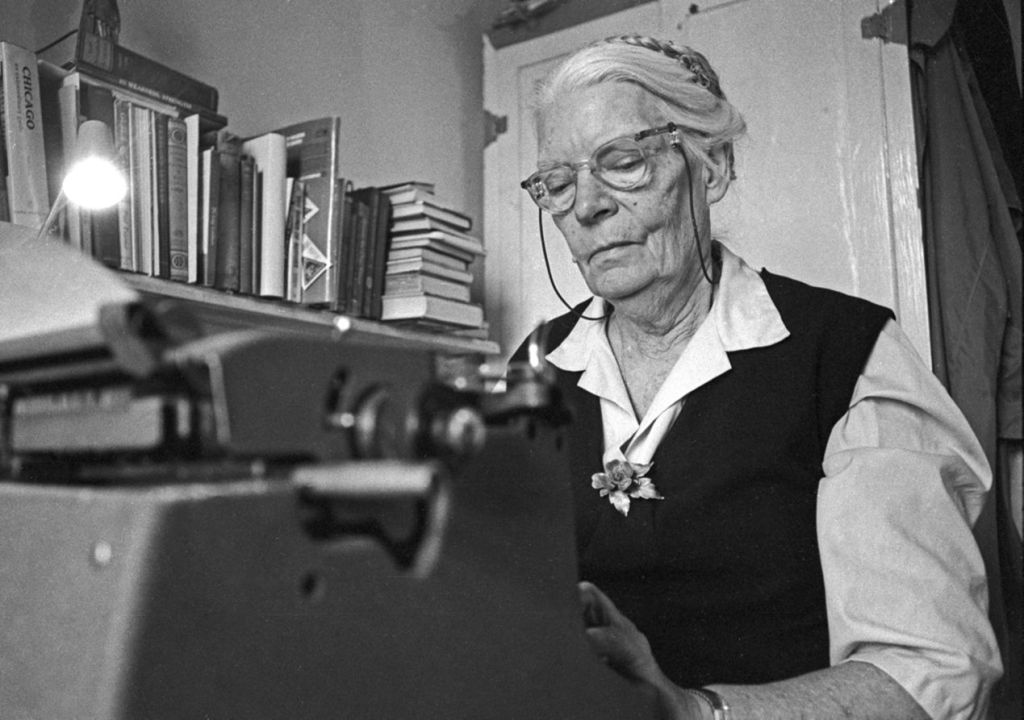
    Day at her typewriter. Credit: Bob Fitch. Source: U.S. Catholic.
  • love & work

    love & work

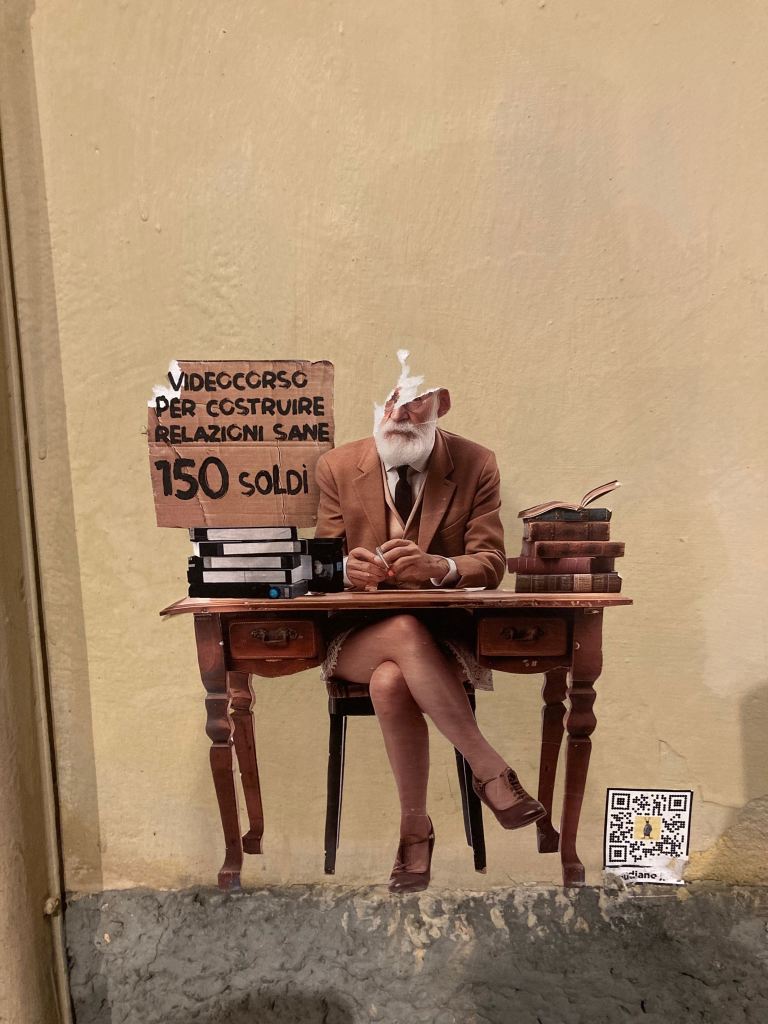
    Graffiti in Florence. “Videocourse for how to construct healthy relationships. 150 dollars.”

    Today my essay on Feminism in Revolt, an edited collection of Carla Lonzi’s work, will come out on Full Stop. I have long been fascinated by Italian feminism, in particular because of the way its writing is often experimental and outside the academic realm. Italian feminism, too, has an entire different universe of concepts unrelated to American feminism which has a hard time thinking past “gender” as a concept, even if it collects a lot of modifiers along the way. It ends up being very monotone and not at all interested in what it means to live and how one might want to do so.

    In my essay on Full Stop, I explore the significance and experimental nature of Lonzi’s writing. She is rarely treated as a writer–only as a critic and feminist. But I think she is an artist, using her life to create new and surprising works. In this post, I’m going to follow a thread that got cut from the essay because it is far more relevant to my blog’s usual themes of living and (not) working. Lonzi’s enactment of feminism, to me, has close ties to an anti-work ethic that many miss if they take her self-narration at face value. Lonzi, at least in the excerpts that we have in English, doesn’t necessary use the language of the anti-work left, which has a strong presence in Italian leftist thought.

    In teaching Lonzi for the first time, I was reminded of how distant Italian feminism is and how useful it is to give some context. Lonzi lived from 1931-1982 and was the cofounder of a group of Italian feminists called Rivolta Feminile. The group experimented with different kinds of consciousness-raising as a way to extract themselves from what they saw as a male-dominated culture. This culture had little respect for different ways of being or living, and its subjectivity was often geared toward profit and the harm of others. One of the key aspects of Rivolta Feminile, like that of the Milan Women’s Bookstore Collective’s philosophy, was that developing autonomous relationships between women was a valid political practice that could create different kinds of freedom. Freedom is often what we see Lonzi searching for in her writing, though she called it “authenticity.”

    Her first book, Autoritratto, or Autoportrait, is a collage of interviews she did with mostly male artists and one woman artist who was also involved with Rivolta Feminile, Carla Accardi. The book is not very enjoyable, in my opinion, but it does mark the end of her career as an art critic. What concerned Lonzi about art-making was the way it destroyed relationships. The language of her critique came from a feminist perspective, of course, critiquing the figure of a male artist’s autonomous subjectivity forsaking the real background that enables and produces him. This would include any women that reproduce his labor. Lonzi also tires of being the critic in that it puts her in service of the art and art world rather than her own subjectivity. In other words, she had to submit her subjectivity to a commodity, even if a special kind of commodity, and that she found intolerable. Refusing the exploitation, she left art criticism altogether.

    She affected a similar kind of leaving with the publication of Vai Pure, a dialogue with her long-term partner, the artist Pietro Consagro. The book is transcription of video recordings that Lonzi took of their final argument. It is, quite frankly, an amazing document. Using her personal experience, Lonzi shines a light on conflicts in relationships that seem universal: the lack of understanding, a lack of gratitude, and a lack of care. But in the context of feminism, this argument takes on a heightened significance as Lonzi is struggling to live out feminism in her day-to-day life with a man she feels does not appropriately appreciate her. Vai Pure is often very funny as Pietro demands examples from Carla as she lists her grievances and as Carla struggles to explain to him the stress of trying to be a feminist while also being partner to a man who doesn’t seem to care a whole lot about feminism.

    Within the written work Pietro publishes he does not (to her mind) acknowledge her role in his art sufficiently. Instead, his work operates on a liberal assumption: “Everyone creates an image of himself, a resumé, grants himself himself his preferred identity” while everyone in his liberal circle, clinging to the “abstract originality of the individual,” consents to the idea that ‘I don’t talk about you, you don’t talk about me” (246). This is an insane basis for art, let alone society. In reproducing the abstract individual who sells his labor willingly and freely (note the language of resume here), Lonzi accuses Pietro of colluding in capitalist subjectivity.

    If that point seems a little, well, abstract, there’s another critique that Lonzi makes which seems even more heartbreaking in its universality and simplicity. Keep in mind that Consagra is an artist, an original freelancer who has some control over his labor. In a translated excerpt of Vai Pure not included in Feminism in Revolt, Lonzi delivers a huge blow:

    I don’t know how to name it. We eat lunch with the feeling that you have to go to the studio, you come back in the evening with the feeling that you must recharge your batteries and in the morning you are off to the studio again … Even when we are at Elba Island [on holiday], you don’t want to go climbing on the rocks, because you want to work on a drawing, on a project, on something, and you accuse me of stealing time from your work. You give me the remainder of your time in the afternoon. We don’t walk around the island, we don’t take walks, we meet people only and exclusively for work, we have restricted the world for ourselves to the people that are interested in your work, whoever they are, clever people or idiots, but it is the work that counts. You must understand that our whole life is structured by work, all of it, that we are never together for ourselves. It’s just a pause, a rest from work. The vital, conscious, and active moment, the promised land is work … You don’t have a schedule, you don’t have a job, you don’t have obligations, but you create a more constraining situation than if you had a job and a boss. (Excerpt translated by Claire Fontaine, in e-flux.)

    Even the artist lives his whole life around work, making time for his partner rather than living his life and making his art an accessory to it. Lonzi has no patience for this; it hurts her deeply to come second to Consagra’s art process.

    Lonzi estranges us from the typical vision of art as an expression of human greatness or creativity. From the perspective of relationships, art is an inhuman process, merely an extension of capitalist production, if a highly specialized one. It is no different than other forms of labor for pay, it just arrogates prestige to itself.

    Lonzi’s entire oeuvre is dedicated to the question: what kind of art can we make if we are unwilling to destroy our lives and relationships? While it’s true that art might outlast us, do we really want to live our lives as if we are already dead?

  • After Burnout

    After Burnout

    “People can die because of the stress of adapting to society. Or they can lose every ounce of their energy. I’ve seen it happen.”
    –Shoji Morimoto, Rental Person Who Does Nothing

    I’ve been writing a book about the stress of graduate school. During that time, I suffered severe burnout. It’s been a couple of years now, though I feel as if I am constantly on the edge of burnout. How do you recover from burnout? I quit my job and moved to Montana where my partner took a new job. I’ve been floating in unemployment while I work on my book, travelling a little. Is idleness the solution to burnout?

    I think and read a lot about idleness as a concept which seems radically other to our moment. We must be doing or consuming at every moment. I find it hard to do nothing, to take a day where nothing must be planned or done. Days filled with TV, online scrolling, work, reproductive labor, it all feels very overwhelming. I’ve always wanted to write a book but that’s still work! And I have a graduate school hangover: every moment could be for writing, so why isn’t it? This is really unhealthy and unhelpful. But difficult to shake.

    I just finished reading Shoji Morimoto’s Rental Person Who Does Nothing, a surprisingly moving account of resisting work and labor. It has made me reflect on my ingrained worked tendencies. It also makes me think about what makes work, well, work and how we might recover from burnout. There is no prescription here: no bubble baths or long walks. (Though you should definitely do those things.) But rather, Morimoto helps us see a way out of burnout through being with others.

    Morimoto became famous a few years ago for receiving requests on twitter, mostly for companionship, and he obliges. He does not get paid, though he often gets his travel reimbursed and gifts from those he fulfills requests for. He lives on savings to support his partner and their kid, spending his day fulfilling requests to do nothing. Often, he watches someone while they work on an essay, goes with them to an event, or eats at a restaurant with him. He does not do labor for others. It is almost a performance art piece, this doing of nothing. And it really is “nothing,” in Morimoto’s words, as he tries to think nothing and say as little as possible in these encounters.

    As I said, reading about idleness a lot, I have come across work with similar ideas to Morimoto’s. I can see parallels between Morimoto and the work of Emi Yagi (Diary of A Void), Jenny O’Dell (How to Do Nothing) and even Luo Huazhong’s “Lie Flat is Justice.” I think Morimoto gets to the heart of what is so radical about doing nothing in his work, much better than I have ever read.

    The origin story of Morimoto’s Rental Person persona is complex and has at least three causes. First, his own alienation at work and through job hunting (of having to be defined by your abilities and skills). Second, tragedy in his own family: his brother’s breakdown and his sister’s suicide. Both were work related. Third, the birth of his child which showed to him that there are points in a human life where we live according to our desires with no repression from within and we receive the unconditional care and resources we need without any expectations for payment. (Later, your parents may blackmail you, but for a while, you’re safe.)

    A central fear that connects all three of these causes is a fear of calcifying into a character, of being made to inhabit a role. Morimoto’s work, as in the book and in his “do nothing” rentals (which aren’t even rentals!), refuses roles entirely. In fact, part of what alienated him about seeking work and then being a worker was that he had to describe himself as if he were a character. Morimoto has an almost superstitious relation to language in that he felt he had to constantly renarrate himself on Twitter to avoid becoming a kind of “character” defined by his consumption, strengths, abilities, and so on.

    Morimoto totally rejects the definition of life as achieving some kind of identity, of stepping into roles that we use to define us, even if they do not encapsulate us–even if they hurt us. Part of what is alienating about roles, as I finally saw reading Morimoto, despite years of thinking about alienation, is that they are always relations of exchange. The worker role sells labor for life. The spouse/child/friend/relation role is about exchanging labor for affection, social status, belonging.

    Morimoto discovers that his own role as Rental Person allows other people to leave the alienating reciprocity of their relationships. He frequently wonders why he is the one receiving requests rather than family or friends. He soon thinks about it this way:

    In Japan people are very conscious of reciprocity. Someone receiving a gift will try to reciprocate with a gift of greater value. This mentality promotes a gift-giving cycle, which helps to sustain relationships. I think people look for similar reciprocity in terms of behaviour between friends. If A does something for B, then B will try to do something more for A. The writer Tomoaki Kageyama describes the sense of obligation that a recipient feels as ‘a healthy feeling of debt’. For me, though, there’s nothing healthy about it at all.

    I think this emphasis on the gift has particular social manifestations in Japan but I feel this acutely in my own life. I feel I must monitor constantly to avoid being a state of social debt. I don’t know why this is the case, except I feel it as an infringement on my freedom, as if every action I take has to be somehow repaid and vice versa. In simpler terms, we are working even in our personal relationships.

    Morimoto argues that the somewhat impersonal nature of social media actually provides a new set of social relations that are less stressful, more human and more humane. He writes that the social media relationship “which falls short of ‘friendship’, can be quite convenient. You don’t feel you have to worry too much about the other person – there’s no sense of expecting anything from each other.” This is why many people do not contact their friends and family, but contact Morimoto instead. There is no social contract. (Except that he needs his travel reimbursement.) Like character, relationships can calcify, become “fixed” and “carry restrictions and responsibilities. Every named relationship entails particular things you have to do, certain expectations that you have to meet.” Thus the unnamed relationships of social media provide us a different model of relating without expectation or obligation.

    This reminds me of Byung-Chul Han’s amazing essay The Burnout Society (video linked, but you should find the book too!). The Burnout Society concludes with a description of a utopian society of the tired. Han hopes for a new kind of social relationship which he calls “friendliness-as-indifference, where “no one and nothing dominates or commands,” a relation that requires “the I [ego] grows smaller” (33). But for the I to get smaller requires a certain giving up of the narcissism and “I”- centeredness of our society of work and competition. Think of Morimoto’s refusal of crafting an identity. That giving up of the “I,” for Han, appears, or originates, as tiredness.

    I find this passage so beautiful:

    This tiredness founds a deep friendship and makes it possible to conceive of a community that requires neither belonging nor relation [Verwandtschaft]. Human beings and things show themselves to be connected through a friendly and.

    This “deep friendship” rests on a “friendly and” something that Morimoto’s work demonstrates clearly, as he feels free to say yes or no to encounters he chooses and never feels constrained by them. Equally, this idea of community predicated on “neither belonging nor relation” is radical and strikes to the heart of almost every political conception of community, left or right. What could friendly tiredness give us, as a society, if we just decided to stop working so hard?

    For Morimoto, like for Luo Huazhong, existing deserves its own recognition and is its own reward. Morimoto’s refusal of exchange in its most oppressive manifestations as well as his refusal to be someone, to try to be a character defined by work and consumption, is about showing to us the ugliness of our social reality. But it also shows us that maybe through each other we can be different.