Since we’ve been on a plane for 13 hours, common sense dictates that everyone would be in a hurry to get off the plane. We would all act with grace and speed, restlessness propelling us forward. This was not the case. I wanted to tear my eyelashes out from impatience as everyone on the plane acted as if they had never deplaned before in their lives. I practically wept to touch the earth again–or at least the floor of the Haneda airport–once I left the suffocating tin can of an airplane.
Airports are funny places, practically their own city-states when you account for their huge populations, multiple security forces, customs and immigration, service workers and maintenance crews. You could probably live in an airport your whole life, with an occasional sad thought for the trees and fresh air.
I was in the limbo of airports, one where you navigate the bureaucratic gauntlet to make it outside. The subtle layer of fear beneath my navigation is a paranoia that I (like some) will not make it out of the airport. I follow a long, desolate hallway that leads to customs and never seems to end. I walk as fast as I can, though I have no idea why. Perhaps I am spurred by a desire to “beat” my fellow passengers who had proven themselves slow and inept in the deplaning process.
In this hallway, there are no creature comforts; there is nowhere to stop for food or water. You must keep moving. On giant banners above us, large Japanese faces smile down at us, kanji printed as tall as I am. I cannot read the kanji, so as far as I’m concerned, they could have been advertising toothpaste or government control.
Immigration is always more confusing than it needs to be, but I followed another piece of travel advice that saved me considerable time. I filled out the online forms first. I can skip the tiny desk with its golf pencils and incomprehensible slips of paper, going straight to the line in which an official will stamp my passport. I get stuck behind a family of three Germans who are giving the official a complex.
He eventually waved them away and I stepped up, handing him my passport. He was a younger Japanese man with tired eyes. A black mustache and goatee matched his short ponytail. He rubbed his eyes behind his glasses as he vaguely gestured. I scan my QR code on the machine in front of me. Neither of us spoke.
My QR code was incorrect, so, with a look of subdued irritation, a flicker of his right eyelid really, he asks for the Japanese address. I show him my AirBnb. He pulled out a scrap of paper and wrote how I needed to enter the information in the program. It turns out I had put all the information in the wrong place. I had failed, already, to be a perfect traveller.
Information now satisfactory, he flipped through my almost empty passport (a stamp for Dublin almost ten years earlier; and London two years ago) and put a sticker with Mt. Fuji on a pink background. I thanked him, in English because I didn’t trust myself to say arigato gozaimasu. He nods impassively and waves me away.
Because I am incapable of moving at a leisurely pace or enjoying my life, I initiate my journey through the rest of the airport with an attitude more fitting for Escape from New York than a twenty-first century airport. I walked faster than was strictly comfortable, dodging slower people and obstacles, picking up speed, until–
Stopped.
For yet another checkpoint.
The Japanese woman who had stopped me smiles behind her mask, pointing to a sign printed in English. I have to fish my passport back out of my bag and scan it at a derelict kiosk. She nods approvingly and I yet again gather speed.
(Aside: it will probably be redundant as I specify whether or not someone is Japanese; this is a bit of a holdover from being in the US. Japan, of course, is full of non-Japanese people, however much they’d like to forget this. But it is less diverse than I’m used to in the United States where affixing identity labels helps illustrate the kind of world we live in).
***
After riding a train in the wrong direction, I eventually got to the Ikebukuro train station. This station is my first stop because of food and because my AirBnB will be nearby.
I had never experienced a train station quite like Ikebukuro and many train stations in Tokyo at least are, in fact, constructed with shops, bathrooms, restaurants. (I hadn’t yet been to Tokyo Station, which blows my mind each time I set food in it.) They are like airports in that way. If you go to New York City, for example, there are not shops in the subways. Given the American penchant for commodifying everything, this seems very strange. But here, in Japan, it seems to be both commercial and a matter of care. Of course people who take trains will be hungry!
The train station would have been more dazzling if I wasn’t so tired and hungry. I was looking for T’s TanTan, a vegan ramen shop. I found it, a tiny place with sliding glass doors. As I stepped inside, the workers shouted something at me, which was very frightening, but now I know they were saying “Irasshaimase,” a polite welcome. You ordered everything via a touch screen, requiring no Japanese. The images explained what the English captions would not. They made cup ramen, as well, so I ordered extra in case I was still hungry at the AirBnB.
They announced your order by number which was a problem because I did not know the numbers, but I took a guess when I saw 2 of their cup ramen on the tray. I hand my receipt to the worker, feeling embarrassed, and she says something I don’t understand so I just smile and nod.
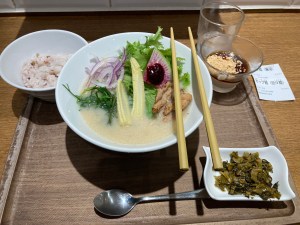
I recognized everything on my plate except the small cup in the upper right hand corner. I wondered: is it some sort of sauce? Am I supposed to dump it into my ramen? I took a taste. I am very glad I didn’t dump it into my ramen. It is my dessert, a coffee liqueur over a yogurt base. I inhale my creamy ramen that has delicious faux-chicken. The rice grains are plump and delicious. The pickles wonderfully sour. Being vegan in Japan is rough-going, so T’s TanTan will be a lifeline while in Tokyo. (I’ll eventually find out they are not in other cities, sadly.)
After practically inhaling my food, I am lost in Ikebukuro station for about twenty minutes before I finally find my way above ground. I am terrified at the idea of getting to my AirBnb which is in a neighboring area called Takada/Toshima City.
It rained, of course, the entire time I walked toward the apartment. It takes me a half hour and my shoulders ache under the weight of my backpack. My roller bag causes my arms to fatigue. The sound of its wheels on the stone made me want to scream in annoyance. My phone screen gathered raindrops. I am tired and am running out of all civilized behaviors as I realize how strangely arranged streets are here. Tokyo streets are like tree branches rather than a grid, some small and dead-ends, other major thoroughfares. I am frequently lost and my google maps loads slowly as it reroutes me again and again.
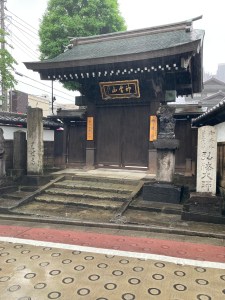
But, through the rain, I get a first glimpse of the Japan. There’s a temple in the neighborhood, its gate closed at this late hour (it’s almost eight o’clock). There are large, gold ideographs on the gate and stone statues on either side. This is from a different history, a different philosophy. The neighborhood is small and seems to me haphazardly arranged, so it will take me another two days to find this gate again.
I eventually find my way to the AirBnB. I am utterly baffled by the door. A Japanese man who is coming out of one of the other apartments sees my distress and attempts to help me. He explains, after my suspicious look, that he cleans these apartments. He smiles behind his mask. Together, we get the door open. I nod my thanks and dart inside.
Later, reflecting on this incident, I felt like I was the rudest person on the whole planet. The Japanese would surely send me home.
My initial appraisal of the room–tired and scared as I was–was not generous. Small and drab I felt (I didn’t even take pictures of it). There was a thin mattress, a small folding couch and a tiny desk in the corner of the bedroom. A door separated it from the kitchen and the bathroom. I came to adore this place and wished my own apartment at home was laid out like this. One of the things I missed the most was the genkan, the small depressed spot at the entry where you leave your shoes before stepping up into the apartment.
This was my first Japanese bathroom. The tub had no shower curtain and the sink and shower shared the same valve mechanism. The tub was big enough for your entire body–American tubs are longer but not deep like Japanese tubs. The entire bathroom was brown except the floating toilet. It was a rather strange color and effect.
I was too tired to do much but lay down on the bed at eight o’clock. Little did I know, I would hardly sleep at all.
 Kaelie Giffel
Leave a comment