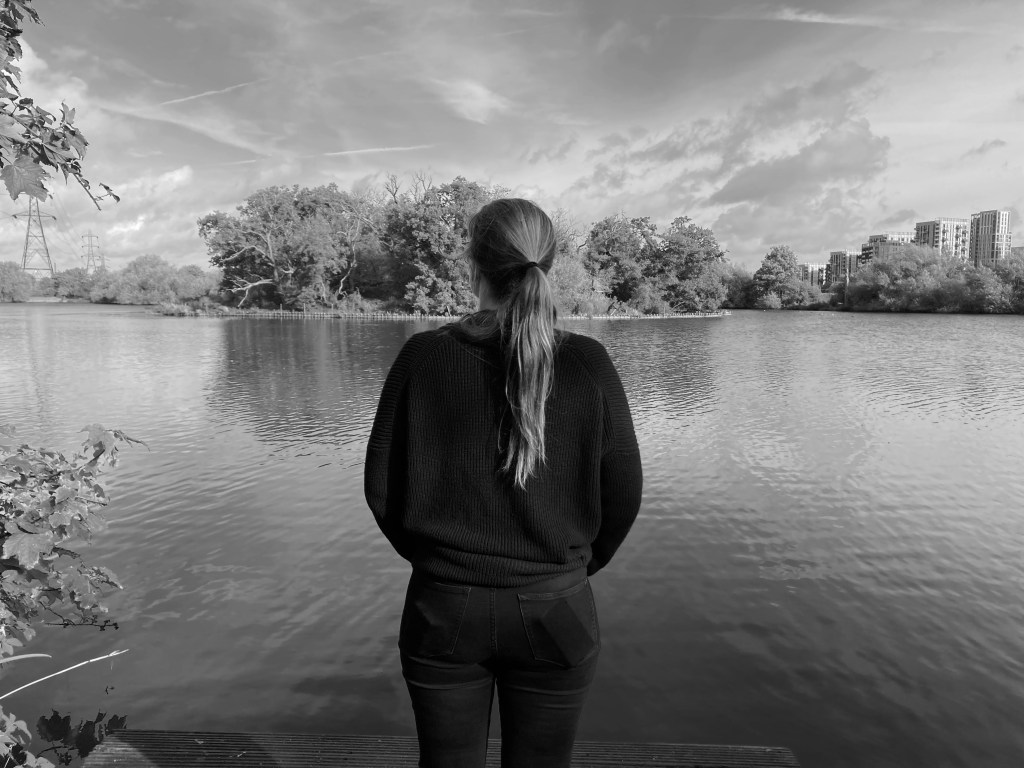
In Claire Dederer’s New Yorker essay about art monsters, she writes:
For me the particular monstrousness of completing my work has always closely resembled loneliness: Leaving behind the family, posting up in a borrowed cabin or a cheaply bought motel room. If I can’t detach myself entirely, then I’m hiding in my chilly office, wrapped in scarves and fingerless gloves, a fur hat plopped upon my head, going hell-for-leather, just trying to finish. Because the finishing is the part that makes the artist. The artist must be monster enough not just to start the work, but to complete it. And to commit all the little savageries that lie in between.
Solitude is defined here as a kind of “savagery,” in which the artist, particularly a woman artist, has to commit some kind of violence to extricate herself from the life around her, literally paying for the time to be alone, to be a separate self. I find this fascinating: there’s something difficult about having a self in day-to-day life for women.
Indeed, solitude would seem to be a natural good, as Sara Maitland observes, of a culture that values individualism, voice, and autonomy. Unfortunately, this culture only nominally values these things. Maitland observes:
We declare that personal freedom and autonomy is both a right and good, but we think anyone who exercises that freedom autonomously is ‘sad, mad or bad’.
Enter the monstrous woman artist who demands time, autonomy, and freedom.
This battle for solitude is also the heart of Sheila Heti’s Motherhood, which could have just as well been called Solitude. In an echo of Maitland and Dederer, Heti writes about the myriad ways in which women’s labor is captured: taking care of men, having children, thinking about having children, having to argue about why they do not want children. Heti is distraught by the ways in which women shrink themselves in space and time, calls women especially “miserly” in the time they allow themselves, whether for their creative processes or for their own self-development.
I’m thinking about this as I’ve finished a second draft of my novel, the final 30,000 words written while I was alone in Durham, NC and before I moved to Montana to join my partner. The first draft of the novel was written last February in an Airbnb in Raleigh where I was free of any responsibility and literally trapped in the rental which had only a coffee maker, toaster, and microwave. (Okay, trapped is a strong word: the neighborhood wasn’t that walkable and there was no way for me to distract myself with shops, walks, making elaborate meals, or going to the gym.) That airbnb cost me about $200 and it was possibly the best money I’ve ever spent in my life.
Why? Because in that space, I felt no implicit or explicit demands on my time, either by my partner or my dogs. I could unspool in time and space. There was nothing to bump into, no one to interrupt my thinking, no one for me to snarl at or project my insecurities onto, I did not have to make myself useful. It was not strange for me to lay in a bed for 7 hours straight and write in a tiny notebook. That this is what it took to write the novel is not surprising but it made me think about my day-to-day life much differently. I could not do the serious work I wanted to do in my own home, as if that space were hostile to who I was and who I wanted to be, a site only of labor and not of rest, creativity and self-exploration.
I think about those brief months of solitude in Durham and wonder about what I have given up in the move: the trade-offs I’ve made. You win some things, like enjoying someone’s company, sharing life with them and all their uniqueness, sharing a meal, not having to commute. And some things are lost or more scarce like solitude (after all, I still have to do that most disagreeable thing, waged labor). Every moment of writing feels hard-won, eked out among interruptions and bad feelings rather than emerging from a jittery excitement like when the space around me was charged with possibility rather than its curtailment. A life of solitude frightened me at the time: but there’s a possibly such a the fright did not belong to me.
 Kaelie Giffel
Leave a comment